Posted by petrus, on February 24th, 2020

(This post is a repeat from previous Leap Days, for the benefit of those for whom this is new material.)
“What?” you’re thinking to yourself, “Leap Day isn’t until the 29th.”
Not according to the Kalendar, which follows the guidelines set forth by Julius Caesar. The ancient Romans had this odd procedure of numbering days . . . → Read More: Felix Dies Bissextum! Happy Leap Day!
Like this:Like Loading...
Posted by isaac, on October 29th, 2017
Given that this year is the 500th anniversary of Martin Luther’s nailing of his (in)famous “Ninety-Five Theses” to the door of the Castle Church of Wittenberg, we thought it would be appropriate to repost them here. (We originally posted them in 2011, along with the original Latin. (Luther actually posted them on . . . → Read More: Disputation on the Power and Efficacy of Indulgences
Like this:Like Loading...
Posted by petrus, on February 25th, 2016
(This post is a repeat from four years ago, but we figure a lot of people might have missed it the first time around.)
“What?” you’re thinking to yourself, “Leap Day isn’t until the 29th.”
Not according to the Kalendar, which follows the guidelines set forth by Julius Caesar. The ancient Romans had this odd . . . → Read More: Felix Dies Bissextum! Happy Leap Day!
Like this:Like Loading...
Posted by petrus, on October 25th, 2015
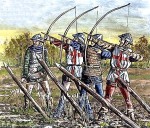
English archers at the Battle of Agincourt
Today is the 600th anniversary of the Battle of Agincourt, one of the most notable battles in the Hundred Years’ War. Henry V’s small English army was able to defeat the numerically superior French forces of Charles VI. Henry V led his own forces into battle, . . . → Read More: The Battle of Agincourt
Like this:Like Loading...
Posted by newsletter, on March 25th, 2015
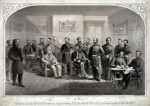
The Ninth of April marks the sesquicentennial of the day on which General Robert E. Lee surrendered his 26,000 men, the remnant of the once invincible Army of Northern Virginia, to General Ulysses S. Grant of the United States Army in the parlour of the McLean House at Appomattox Courthouse in Virginia.
It occurred four . . . → Read More: Recalling General Lee’s surrender
Like this:Like Loading...
Posted by Fr Guy Hawtin, on October 21st, 2014
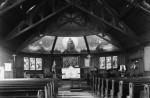
The church as it appeared in 2001, before the enclosure of the front porch.
Looking back on it, it seems little short of miraculous that such a small congregation could have raised the money to build a million dollar-plus church—and that is a million-plus in 1990 dollars, not in today’s sadly devalued specie. . . . → Read More: The talented team that raised the cash
Like this:Like Loading...
Posted by petrus, on February 25th, 2012
“What?” you’re thinking to yourself, “Leap Day isn’t until the 29th.”
Not according to the Kalendar, which follows the guidelines set forth by Julius Caesar. The ancient Romans had this odd procedure of numbering days by counting backwards from certain landmark days in the month, viz., the Kalends, the Ides, and the Nones.
The Kalends . . . → Read More: Felix Dies Bissextum! Happy Leap Day!
Like this:Like Loading...
Posted by petrus, on November 11th, 2011
Most Americans probably think of November 11 as Veterans Day, but a number are old enough to remember it as “Armistice Day”, marking the conclusion of World War I, the “Great War”. But to residents of the Commonwealth nations, it is Remembrance Day.
As part of their Remembrance Day observance, residents of the Commonwealth . . . → Read More: Remembrance Day
Like this:Like Loading...
Posted by petrus, on November 1st, 2011
So did you recognize the document in this post? These are the (in)famous “Ninety-Five Theses” of Martin Luther, which he nailed to the door of the Castle Church of Wittenberg on October 31st, 1517. This is why our Lutheran brethren celebrate Reformation Sunday on the last Sunday in October (transferring the observance to . . . → Read More: Disputation on the Power and Efficacy of Indulgences
Like this:Like Loading...
Posted by petrus, on October 31st, 2011
A Hallowe’en challenge for you:
1. Dominus et magister noster Iesus Christus dicendo `Penitentiam agite &c.’ omnem vitam fidelium penitentiam esse voluit.
2. Quod verbum de penitentia sacramentali (id est confessionis et satisfactionis, que sacerdotum ministerio celebratur) non potest intelligi.
3. Non tamen solam intendit interiorem, immo interior nulla est, nisi foris operetur varias carnis . . . → Read More: Disputatio pro Declaratione Virtutis Indulgentiarum
Like this:Like Loading...
|
Category-Specific RSS Feeds |


 Comments are closed




 Newsletter